
Will AI Replace Programmers?
A Roadmap to Surviving and Thriving in an AI-Driven World
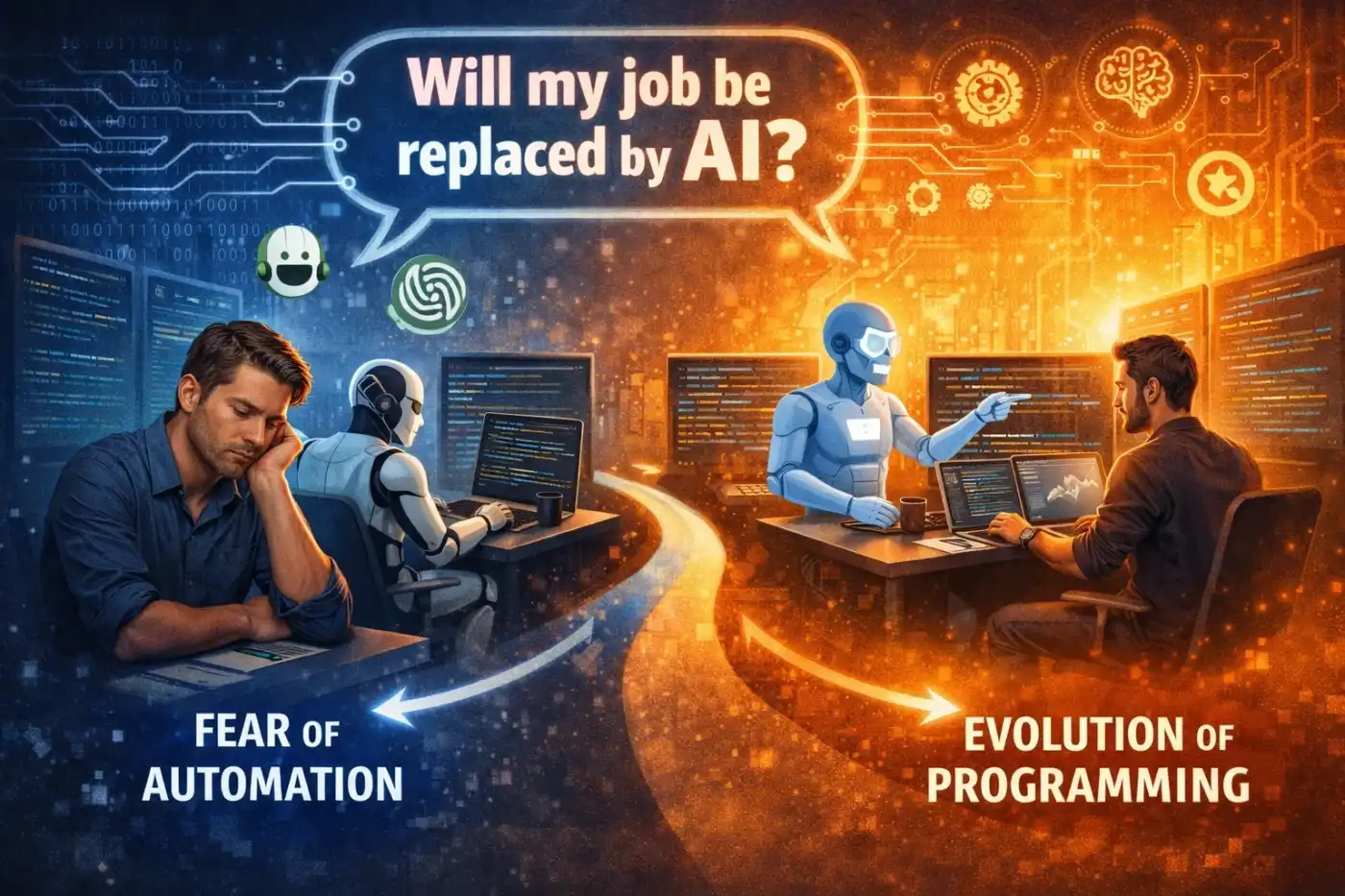
The rise of artificial intelligence (AI) has many programmers asking a pressing question: "Will my job be replaced by AI?" With tools like GitHub Copilot and ChatGPT now assisting in coding, the fear of automation is real. But the truth is more nuanced. Programming, traditionally a white-collar profession, is evolving rather than disappearing.
Is Programming a White-Collar Job?
Programming fits the classic definition of a white-collar profession. White-collar roles are intellectual, office-based, and require specialised knowledge. Programmers design software, solve logical problems, and create systems--tasks that demand mental rather than physical labour. Most programming roles require education, training, and problem-solving expertise, and they often provide professional recognition and career growth. In short, programming is firmly in the white-collar category.
AI in Programming Today
AI has made remarkable inroads into programming:
- It can suggest code snippets and templates.
- It automates repetitive tasks and performs debugging assistance.
- It generates documentation and helps with code testing.
Despite this, humans remain indispensable for:
- Understanding business requirements and system context.
- Architecting software for long-term scalability.
- Making ethical decisions regarding privacy, security, and legal compliance.
- Integrating systems and solving complex, real-world problems.
Why Programmers Won't Be Fully Replaced Soon
While AI can accelerate coding, several human-only skills keep programmers relevant:
- Context understanding: AI lacks the nuance of human reasoning in business and user experience.
- Creativity: Algorithm design, system optimisation, and innovation require human insight.
- Ethics and responsibility: Humans must oversee AI-generated decisions in security and compliance.
- Maintenance and debugging: Large-scale, real-world systems require human supervision.
Experts predict that in the next 5-10 years, AI will handle routine coding tasks, while humans remain responsible for architecture, planning, and creative problem-solving. True "full automation" of programming is highly improbable in the near term.
Who Survives the AI Revolution in Programming?
Not all programmers are equally exposed to automation risk. Survivors tend to be:

- Programmers with diverse skills in software design, web development, and content creation.
- Those combining technical expertise with entrepreneurial vision.
- Developers actively learning to integrate AI tools into their workflow.
If you are building projects, running businesses, or experimenting with new software, you fall into the "AI-augmented survivor" category. Your skills cannot be entirely replaced by AI because you contribute creativity, strategy, and human context.
AI-Augmented Skills Roadmap for Programmers
1. Core Programming Skills
- Algorithms & data structures: Fundamental for problem-solving.
- Full-stack web development: Versatility in front-end and back-end design.
- Database design: Complex decision-making beyond AI capabilities.
- Debugging & testing: Human reasoning still required for complex issues.
2. AI-Assisted Workflow
- Leverage GitHub Copilot and ChatGPT to automate repetitive coding tasks.
- Use AI for automated testing, linting, and performance checks.
- Integrate low-code/no-code platforms for rapid prototyping.
- Utilise AI to generate initial documentation or content ideas, adding your unique insights.
3. Creative and Entrepreneurial Edge
- UI/UX and design thinking: Human-centred software design remains irreplaceable.
- Content creation: Storytelling and marketing differentiate products.
- Project management and client relations: AI cannot inspire or negotiate.
- Product vision: Humans lead innovation and strategic decisions.
4. Future-Proof Programming Roles
- AI-assisted developers: Use AI to accelerate coding while focusing on architecture.
- Full-stack product developers: Build end-to-end software integrating UX and business logic.
- Technical entrepreneurs: Launch and scale products leveraging AI for efficiency.
- Creative tech specialists: Merge programming with art, design, and content creation.
- AI ethics & oversight engineers: Ensure AI outputs remain responsible and unbiased.
5. Action Plan for the Next 12-24 Months
- Master AI-assisted coding tools like Copilot and ChatGPT.
- Strengthen full-stack development and database skills.
- Develop creative differentiation through UI/UX and storytelling.
- Launch small products to apply coding in real-world business contexts.
- Document and blog your process to establish authority.
- Network with other developers and entrepreneurs for collaboration.
Conclusion
AI is transforming programming, but it is not eliminating human developers. The future belongs to programmers who can leverage AI to automate routine work while retaining their creative, strategic, and entrepreneurial skills. By mastering core programming, integrating AI tools, and building unique products, you position yourself firmly in the AI-augmented survivor group.

Ultimately, your value is defined not just by what you code, but by how you innovate, solve complex problems, and create products that matter.


Recommended Affiliate Resources







You May Also Like

The Complete Guide to Laptop Overheating
Few things frustrate computer users more than a laptop that suddenly becomes hot, noisy, and painfully slow.…
Read More »
HP ProBook 450 G7 SSD Not Detected During Windows 11 Installation
Few things are more frustrating than preparing everything correctly for a clean Windows installation, only to…
Read More »
Best Creative Artist Companion: Wacom Cintiq Pro Series Review
Wacom Cintiq Pro Series Review Discover why the Wacom Cintiq Pro Series is the preferred choice for creative…
Read More »
Galaxy S25 FE Review: Why It’s the Perfect Smartphone
Discover why the Galaxy S25 FE is the perfect blend of premium features and budget-friendly pricing. In the…
Read More »
Why Won’t My PC Turn On? Fixes That Work
One moment, your desktop is humming along just fine; the next, the power button does absolutely nothing. No…
Read More »
How to Speed Up a Slow Desktop PC:
Picture this: you sit down at your desk, eager to dive into work or creativity, only to be greeted by a…
Read More »Traffic Coop Earnings
Ready to Monetise Your Traffic?
Stop letting your visitors slip away without value. With the LeadsLeap Co-op, you can turn every click into income. Join through my link below and I’ll personally share my tips for getting started fast.
Join My LeadsLeap Co-op Now
About the Author
Hello, I'm Patrick Wilson — an entrepreneur, artist, and storyteller driven by curiosity and passion. Through this blog, I explore and share meaningful content around a wide spectrum of lifestyle and success topics that matter to everyday people looking to live better, earn more, and grow intentionally.
From building a personal brand and making money online through proven digital strategies, to navigating the journey of personal finance and wealth-building — I bring real-world insights and tools to help you take control of your financial future.
I also document my pursuit of a healthy, balanced life — sharing inspiration around achieving fitness goals and living with purpose. As someone who appreciates both the aesthetic and the soulful, I dive deep into fine art, cultural history, and the enriching nuances of everyday lifestyle.
Whether I'm exploring breathtaking travel destinations across the globe or tending to the joys of home and garden, I aim to bring beauty, clarity, and useful ideas to every post.
If you're passionate about growth — financially, creatively, or personally — this blog is designed to inspire and support your journey.
Thanks for being here — let's grow together.