
MageNet Review 2025: Monetise Your Blog Easily
MageNet Review 2025: Monetise Your Blog with Contextual Links That Actually Make Sense
If you have ever poured hours into writing a high-quality blog post, hit publish, and then watched it generate little to no income, you are not alone. For many bloggers, content creation is deeply satisfying, but monetisation often feels frustrating, inconsistent, or even intrusive.
Display adverts slow down websites and hurt user experience. Affiliate banners are frequently ignored. Sponsored posts require endless emails, negotiations, and revisions. In short, most monetisation methods demand either constant effort or visible compromises to your site.
This is exactly why contextual link monetisation has gained serious traction over the last few years. And one of the platforms leading this space is MageNet.
In this in-depth MageNet review for 2025, you will learn exactly how MageNet works, what makes it different from traditional ad networks, how much you can realistically earn, and whether it is a good fit for your blog or content-driven website.
What Is MageNet?
MageNet is a contextual link marketplace that connects advertisers with website publishers. Instead of showing banners or pop-ups, MageNet places relevant text-based links directly inside existing blog content.
These links are contextual, meaning they appear naturally within sentences, paragraphs, or sections that are already relevant to the advertiser's topic. The result is monetisation that feels organic rather than disruptive.
As a publisher, you keep full ownership of your content. MageNet simply helps turn your articles into monetised assets by matching them with suitable advertisers who want exposure through contextual mentions.
In plain terms, MageNet allows you to earn passive income by linking relevant brands or services inside posts you have already written.
How MageNet Works for Publishers
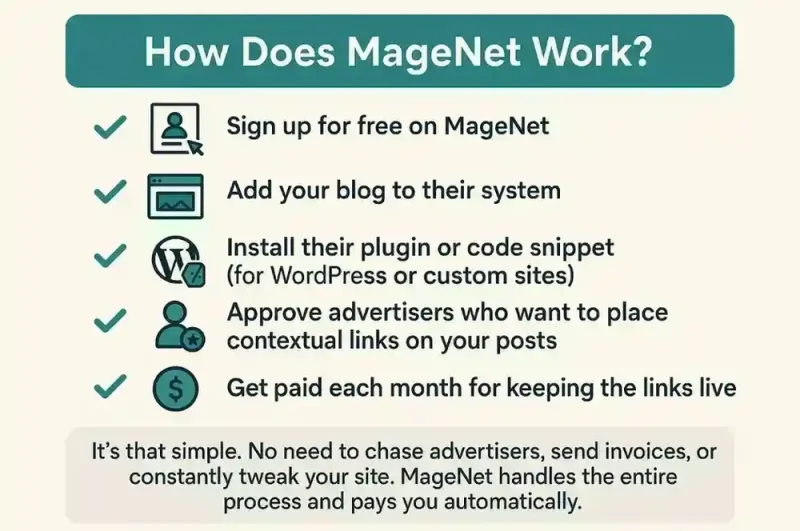
MageNet is designed to be simple and hands-off. The entire process can be broken down into a few clear steps.
1. Sign Up and Submit Your Website
You begin by creating a free MageNet account and submitting your website for review. MageNet evaluates sites based on content quality, originality, niche relevance, and overall trustworthiness.
This quality control is important because it protects advertisers and ensures that publishers who are accepted tend to receive better offers.
2. Install the MageNet Code or Plugin
Once approved, you install MageNet's tracking script or plugin. WordPress users can use a plugin, while custom CMS users can add a lightweight code snippet.
The installation does not affect your site speed or layout and does not inject visible adverts.
3. Review and Approve Advertisers
Advertisers submit requests to place contextual links on relevant pages. You have full control over which advertisers you approve and which content can be monetised.
This approval process ensures that links remain relevant, trustworthy, and aligned with your brand.
4. Earn Monthly Passive Income
Once links are live, you earn money for keeping them active. Payments are handled automatically, and you receive your earnings on a monthly basis.
There is no outreach, no invoicing, and no ongoing maintenance required.
Why Contextual Links Outperform Traditional Ads
Contextual links offer several advantages over display advertising and aggressive affiliate tactics.
- They blend naturally into content, improving user experience.
- They are content-driven, not design-driven.
- They do not affect page speed or Core Web Vitals.
- They attract higher-quality clicks due to relevance.
Because contextual links appear within meaningful content, users are more likely to trust them. This trust benefits advertisers and results in more stable earnings for publishers.
Key Benefits of Using MageNet
1. True Passive Income
Once MageNet is set up, your existing content can continue earning without additional work. Even articles written years ago can suddenly start generating revenue.
2. No Visual Clutter
Your site remains clean, professional, and reader-focused. There are no banners, pop-ups, or distracting ad blocks.
3. Works with Evergreen Content
MageNet performs especially well on evergreen articles that consistently attract search traffic. These posts quietly earn in the background.
4. Suitable for Custom CMS and WordPress
Unlike many monetisation tools that cater only to WordPress, MageNet works equally well with custom-built content management systems.
5. Publisher Control
You choose which advertisers to approve, which links stay live, and which pages are eligible.
MageNet Pros and Cons
Advantages
- Free to join with no upfront costs
- Simple setup process
- Hands-off monetisation model
- Does not hurt site aesthetics or performance
- Works on old and new content
Disadvantages
- Earnings vary by niche and traffic volume
- Not all websites are accepted
- Limited control over anchor text suggestions
Overall, the pros significantly outweigh the cons for most content-focused publishers.
How Much Can You Earn with MageNet?
Earnings with MageNet depend on several factors:
- Your website's traffic levels
- Content quality and topical relevance
- Authority and backlink profile
- Niche demand from advertisers
Some smaller blogs earn modest amounts each month, while established sites with strong organic traffic can earn hundreds or even thousands over time.
The key advantage is that MageNet income is incremental. It adds an extra revenue layer without replacing existing monetisation strategies.
Who Should Use MageNet?
MageNet is particularly well suited for:
- Bloggers who prioritise user experience
- Publishers with large archives of content
- Affiliate marketers seeking diversification
- Websites rejected by premium ad networks
- Content creators using custom CMS platforms
If your site relies heavily on informational or evergreen content, MageNet is a natural fit.
Is MageNet Safe for SEO?
When used correctly, MageNet is safe for search engine optimisation. The links are contextual, relevant, and placed within meaningful content.
As with any monetisation tool, moderation is important. Avoid overloading pages with links and ensure that only relevant advertisers are approved.
Many publishers successfully use MageNet alongside organic SEO strategies without ranking issues.
MageNet vs Display Ads
Compared to traditional display advertising, MageNet offers a more refined approach:
- No layout shifts or CLS problems
- No ad-blocker dependency
- Better alignment with content strategy
- Improved reader trust
This makes MageNet especially attractive for blogs focused on long-term growth rather than short-term ad revenue.
Final Verdict: Is MageNet Worth It in 2025?
MageNet is not a magic solution that will instantly replace all your income streams. However, it is one of the cleanest, least intrusive monetisation methods available to bloggers today.
If you value your readers, want to preserve site performance, and prefer passive income over constant outreach, MageNet is absolutely worth considering.
It works quietly in the background, turning your content into a sustainable asset rather than a one-time effort.
How to Get Started with MageNet
If you already have quality content and steady traffic, getting started with MageNet takes very little time.

Create an account, submit your site, and let your content start working for you.
Monetise smarter, not louder.

Join MageNet Now

Recommended Affiliate Resources







You May Also Like

Best Free AI Video Generators in 2025
As a blogger, affiliate marketer, or online entrepreneur, one of the greatest challenges is creating…
Read More »
Watching My Website's Pages Vanish from Google
When I first launched my website, I was ecstatic. Every new blog post I published seemed to appear almost…
Read More »
The Complete Affiliate Marketing Pillar Guide
Affiliate marketing has evolved from a simple referral system into one of the most powerful online income…
Read More »
My SEO Journey: Overcoming Challenges & Wins
SEO has always felt like chasing a moving target. Some days, it seems like you've cracked the code -- your…
Read More »
Has AI Killed Blogging?
The rise of artificial intelligence has sparked fear, confusion, and endless debates across the online world.…
Read More »
How to Make Money with Affiliate Marketing by Placing Ads
I often share ways to make money with affiliate marketing on this channel, but placing ads on well-known…
Read More »Traffic Coop Earnings
Ready to Monetise Your Traffic?
Stop letting your visitors slip away without value. With the LeadsLeap Co-op, you can turn every click into income. Join through my link below and I’ll personally share my tips for getting started fast.
Join My LeadsLeap Co-op Now
About the Author
Hello, I'm Patrick Wilson — an entrepreneur, artist, and storyteller driven by curiosity and passion. Through this blog, I explore and share meaningful content around a wide spectrum of lifestyle and success topics that matter to everyday people looking to live better, earn more, and grow intentionally.
From building a personal brand and making money online through proven digital strategies, to navigating the journey of personal finance and wealth-building — I bring real-world insights and tools to help you take control of your financial future.
I also document my pursuit of a healthy, balanced life — sharing inspiration around achieving fitness goals and living with purpose. As someone who appreciates both the aesthetic and the soulful, I dive deep into fine art, cultural history, and the enriching nuances of everyday lifestyle.
Whether I'm exploring breathtaking travel destinations across the globe or tending to the joys of home and garden, I aim to bring beauty, clarity, and useful ideas to every post.
If you're passionate about growth — financially, creatively, or personally — this blog is designed to inspire and support your journey.
Thanks for being here — let's grow together.