
Candle Patterns & High-Probability Trading Strategies
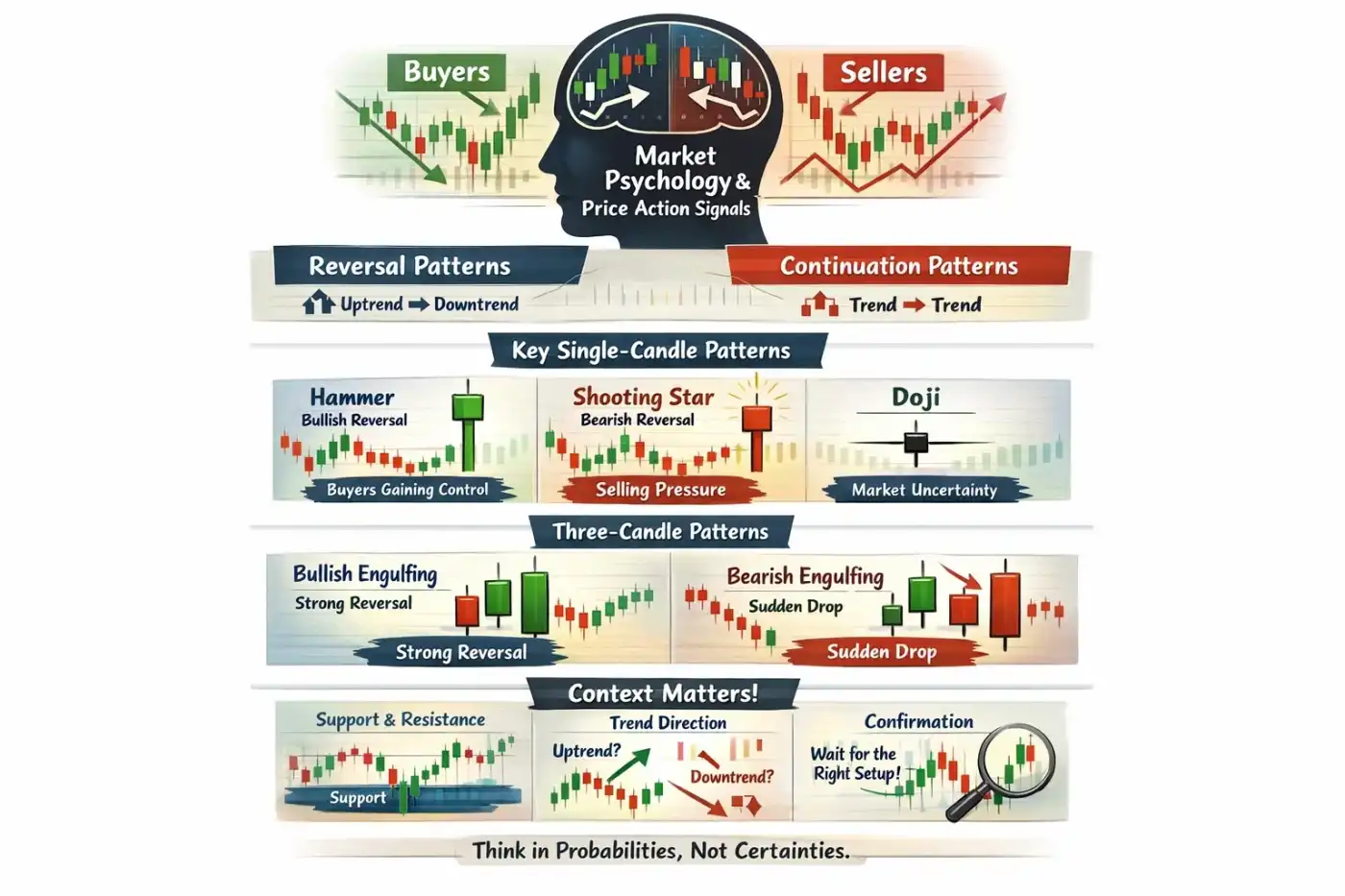
Candles, Market Structure, and High-Probability Trade Entries Explained: A Complete Practical Guide for Consistent Trading Decisions
Financial markets move in patterns shaped by human behaviour, liquidity, institutional participation, and repeating psychological cycles. Traders who rely purely on indicators often struggle because indicators lag behind price. Professional traders instead learn to read price directly through three interconnected concepts: candle behaviour, market structure, and precise trade entry logic. When these three elements align, trading becomes less about guessing and more about structured probability.
This guide explains how candles communicate intent, how market structure reveals directional bias, and how traders identify high-probability entries without unnecessary complexity. Whether you trade forex, indices, crypto, or commodities, these principles remain universal because price action reflects order flow rather than platform or asset differences.
Throughout this article, you will learn:
- How to interpret candlestick behaviour beyond simple patterns
- How market structure defines trend continuation and reversals
- Why liquidity drives most price movements
- How to identify high-probability trade entries step by step
- How to avoid common retail trading mistakes
Let us begin with the most fundamental language of markets: the candle.
Understanding Candlestick Behaviour: Reading Market Intent Through Price Action
Candlesticks are more than visual representations of price movement. Each candle records the battle between buyers and sellers within a specific time window. Understanding this interaction transforms charts from random motion into readable market communication.
The Anatomy of a Candle
Every candlestick contains four essential data points: open, high, low, and close. While beginners often memorise candle names, experienced traders focus instead on the relationship between these values.
A strong bullish candle closing near its high shows aggressive buying pressure. Conversely, a bearish candle closing near its low suggests dominant selling activity. The position of the close matters far more than the size alone.
Key candle components include:
- Body: Distance between open and close
- Upper wick: Rejected higher prices
- Lower wick: Rejected lower prices
- Range: Total volatility during the period
Long wicks often signal liquidity sweeps or failed attempts by one side of the market to maintain control.
What Candles Reveal About Market Psychology
Each candle represents decisions made by thousands or millions of participants. A sudden expansion candle often indicates institutional involvement because large capital creates momentum impossible for retail traders alone.
For example:
- Large impulsive candles suggest imbalance.
- Small overlapping candles indicate indecision.
- Repeated rejection wicks reveal liquidity testing.
Instead of memorising dozens of candlestick patterns, focus on three behavioural questions:
- Who is currently in control?
- Did price accept or reject a level?
- Is momentum increasing or weakening?
These questions simplify analysis dramatically.
Impulse vs Correction Candles
Markets alternate between expansion and correction phases. Impulsive candles move decisively in one direction with strong closes and minimal overlap. Corrective candles move slowly, overlap frequently, and often form consolidation ranges.
Understanding this distinction allows traders to avoid entering during low-probability phases. High-probability trades typically occur when price transitions from correction back into impulse.
This concept connects directly with broader market structure analysis discussed later.
Liquidity and Candle Formation
Many traders misunderstand sudden spikes as randomness. In reality, these movements frequently occur when price targets areas where stop losses accumulate. Liquidity pools form above highs and below lows because traders naturally place stops there.
When price reaches these zones:
- Stops trigger market orders.
- Liquidity becomes available.
- Institutions execute larger positions.
The resulting candle often shows a sharp wick followed by reversal or continuation.
Timeframe Alignment
A common mistake is analysing candles on a single timeframe. Professional traders compare multiple timeframes simultaneously.
- Higher timeframe candles define direction.
- Lower timeframe candles refine entries.
For instance, a bullish daily candle combined with bearish five-minute candles may simply represent a pullback rather than a reversal.
Common Misinterpretations Traders Make
Many beginners rely excessively on named candle patterns such as engulfing or pin bars without context. A pattern alone holds little meaning unless supported by structure and liquidity.
A bullish engulfing candle inside resistance often fails. The same candle at structural support after liquidity removal carries far higher probability.
The lesson is simple: candles communicate context, not certainty.
Once candle behaviour becomes clear, the next step is understanding where price sits within the broader market narrative -- market structure.
Market Structure: The Framework That Defines Trend, Reversal, and Bias
Market structure provides the logical framework that explains why price moves the way it does. While candles show short-term behaviour, structure reveals long-term intent.
Without structure, traders enter randomly. With structure, every trade aligns with directional logic.
What Is Market Structure?
Market structure refers to the sequence of highs and lows formed by price movement. These sequences reveal whether buyers or sellers maintain control.
There are three primary structural conditions:
- Uptrend: Higher highs and higher lows
- Downtrend: Lower highs and lower lows
- Range: Equal highs and lows within boundaries
Identifying these conditions eliminates emotional trading decisions.
Break of Structure (BOS)
A break of structure occurs when price decisively violates a previous swing high or low in the direction of momentum. This signals continuation rather than reversal.
Characteristics of a valid structural break include:
- Strong impulsive candle movement
- Clear close beyond previous swing point
- Minimal hesitation after breakout
Weak breaks often result in false signals.
Change of Character (ChoCH)
A change of character signals potential reversal. It occurs when price breaks the opposing structural level after a trend shows exhaustion.
For example, during an uptrend:
- Price stops creating higher highs.
- A lower low forms.
- Momentum shifts downward.
This shift indicates that market control may be transferring between buyers and sellers.
Internal vs External Structure
Markets operate on multiple structural layers.
- External structure: Major swing highs and lows
- Internal structure: Smaller movements within swings
High-probability traders align entries with external direction while using internal structure for precision timing.
Liquidity Zones Within Structure
Structure alone is incomplete without liquidity understanding. Highs and lows attract stop orders, making them natural targets for price.
Common liquidity areas include:
- Previous daily highs and lows
- Equal highs or equal lows
- Range boundaries
- Trendline clusters
Price frequently sweeps these zones before moving toward its true direction.
Premium and Discount Concepts
Another structural idea involves evaluating whether price trades at a premium or discount relative to a swing range.
- Upper half of range = premium (selling interest)
- Lower half of range = discount (buying interest)
This perspective prevents chasing entries at poor locations.
Market Phases
Every market cycles through accumulation, expansion, distribution, and reversal phases.
Understanding these phases helps traders anticipate behaviour:
- Accumulation: consolidation before trend
- Expansion: strong directional movement
- Distribution: slowing momentum
- Reversal: structural shift
Recognising phase transitions dramatically improves timing.
Once traders understand structure, the final step is learning how to convert analysis into actionable entries.
High-Probability Trade Entries: Combining Candles and Structure for Precision Execution
A high-probability trade entry occurs when candle behaviour, liquidity positioning, and market structure align simultaneously. No single signal guarantees success; probability emerges from confluence.
The Concept of Confluence
Confluence means multiple independent factors support the same trading idea.
Typical confluence elements include:
- Trend direction from higher timeframe structure
- Liquidity sweep
- Strong rejection candle
- Return to imbalance or value area
The more aligned factors present, the stronger the setup.
The Three-Step Entry Model
Many professional traders follow a structured sequence.
1. Identify Direction
Use higher timeframe structure to determine bias. Trading against structure significantly lowers probability.
2. Wait for Liquidity Interaction
Price often moves into stop clusters before reversing. Patience during this phase separates disciplined traders from impulsive ones.
3. Confirm With Candle Behaviour
Entry occurs only after confirmation, such as:
- Strong rejection wick
- Engulfing impulse candle
- Break of internal structure
Entry Techniques Traders Use
Several refined entry approaches exist.
Pullback Entry
After an impulsive move, price retraces into a previous imbalance before continuing. Traders enter at discounted prices rather than chasing momentum.
Break and Retest
Price breaks structure, returns to test the level, then resumes direction. Confirmation candles improve accuracy.
Liquidity Sweep Reversal
Price briefly breaks a high or low, triggers stops, then reverses strongly. This setup often produces sharp moves.
Risk-to-Reward Optimisation
High-probability trading focuses on asymmetric risk. Rather than winning frequently, traders aim for favourable reward ratios.
Typical principles include:
- Risk small percentage per trade
- Place stop beyond structural invalidation
- Target opposing liquidity zones
Consistent application matters more than individual outcomes.
Entry Timing Using Lower Timeframes
Once higher timeframe bias is clear, traders refine entries using smaller charts. This approach reduces stop distance while maintaining directional alignment.
For example:
- Daily chart defines trend
- One-hour chart shows pullback
- Five-minute chart provides entry trigger
Avoiding Overtrading
High-probability setups do not appear constantly. Many losses occur because traders force trades during consolidation.
Professional traders often take fewer trades but with stronger reasoning.
Trade Management After Entry
Execution does not end at entry.
- Move stop loss only after structural confirmation.
- Partial profits may reduce psychological pressure.
- Avoid emotional exits during normal pullbacks.
Strong management preserves edge over long periods.
Understanding entries is powerful, but long-term success depends equally on avoiding common mistakes.
Common Trading Mistakes and How Professionals Maintain Consistency
Even traders who understand candles and structure often fail due to behavioural errors. Consistency requires discipline, patience, and process-based thinking.
Mistake 1: Trading Without Context
Entering based solely on candle patterns without structural alignment leads to inconsistent results. Context always precedes execution.
Mistake 2: Ignoring Liquidity
Retail traders frequently place stops at obvious locations. Markets naturally target these zones before moving in the intended direction.
Understanding liquidity transforms frustration into expectation.
Mistake 3: Over-Reliance on Indicators
Indicators summarise past price. When traders stack multiple indicators, signals often conflict.
Price action already contains the raw data indicators attempt to interpret.
Mistake 4: Poor Risk Management
No strategy survives excessive risk. Professionals focus on capital preservation first.
- Risk consistency matters more than profit size.
- Losses are operational expenses.
- Survival enables long-term compounding.
Mistake 5: Emotional Decision-Making
Fear and greed distort judgement. Traders exit winners early and hold losing trades too long when emotions dominate.
Structured rules reduce emotional interference.
Building a Repeatable Trading Process
A professional workflow often follows this routine:
- Analyse higher timeframe structure
- Mark liquidity areas
- Wait for price interaction
- Confirm with candle behaviour
- Execute predefined risk plan
Consistency arises from repeating process rather than predicting outcomes.
The Role of Patience
Markets reward patience disproportionately. Waiting for alignment between candles, structure, and liquidity dramatically improves probability.
Many profitable traders spend more time observing than trading.
Long-Term Skill Development
Trading mastery develops gradually through deliberate practice. Journalling trades, reviewing mistakes, and refining rules create measurable improvement.
Focus on:

- Execution quality
- Decision reasoning
- Emotional stability
Final Perspective
Candles provide the language of price. Market structure provides context. High-probability entries provide execution. When combined with disciplined risk management, these elements form a professional trading framework adaptable across all markets and timeframes.
The goal is not perfection but repeatable decision-making based on observable behaviour. Traders who internalise these principles gradually transition from reactive trading to strategic participation -- where probability replaces prediction.



Recommended Affiliate Resources







You May Also Like

Earning Serious Money with MetaTrader 4
MetaTrader 4 (MT4) has remained one of the most trusted trading platforms in the financial markets for more…
Read More »
Earning Serious Money with MetaTrader 5
MetaTrader 5 (MT5) has become one of the most powerful trading platforms available for modern financial…
Read More »
Why Forex Feels Like an Emotional Rollercoaster
Anyone who has dipped their toes into forex trading knows the experience is far from smooth. One moment…
Read More »
Forex Trading Mood Swings: Memes for Every Trader
Forex trading is not just about charts, candlesticks, and economic calendars. It's also about the emotional…
Read More »
Why My Affiliate Binary Options Is Better Than Yours
Pocket Options has recently introduced several innovative features designed to enhance the user experience .…
Read More »
Turkish Lira (TRY) vs Euro (EUR): Market Sentiment and Outlook
The Turkish lira's exchange rate against the euro (EUR/TRY) has become one of the most important barometers…
Read More »Traffic Coop Earnings
Ready to Monetise Your Traffic?
Stop letting your visitors slip away without value. With the LeadsLeap Co-op, you can turn every click into income. Join through my link below and I’ll personally share my tips for getting started fast.
Join My LeadsLeap Co-op Now
About the Author
Hello, I'm Patrick Wilson — an entrepreneur, artist, and storyteller driven by curiosity and passion. Through this blog, I explore and share meaningful content around a wide spectrum of lifestyle and success topics that matter to everyday people looking to live better, earn more, and grow intentionally.
From building a personal brand and making money online through proven digital strategies, to navigating the journey of personal finance and wealth-building — I bring real-world insights and tools to help you take control of your financial future.
I also document my pursuit of a healthy, balanced life — sharing inspiration around achieving fitness goals and living with purpose. As someone who appreciates both the aesthetic and the soulful, I dive deep into fine art, cultural history, and the enriching nuances of everyday lifestyle.
Whether I'm exploring breathtaking travel destinations across the globe or tending to the joys of home and garden, I aim to bring beauty, clarity, and useful ideas to every post.
If you're passionate about growth — financially, creatively, or personally — this blog is designed to inspire and support your journey.
Thanks for being here — let's grow together.