A practical look at the evidence and limits
 The Alchemy of Botanical Sedation is worth approaching carefully, because traditional use, personal comfort, and medical evidence are not the same thing. This post keeps the focus on traditional use, safety limits, suitability, and the difference between general wellness information and medical advice without turning general information into medical certainty. In current discussions about herbal wellness, the intersection of ethnobotany and basic plant chemistry and fermentation presents an area that needs careful study. This exploration focuses on the careful preparation of sedative herbs found within the Central Highlands and beyond, specifically examining how yeast fermentation transforms raw plant material into plant compounds that may become easier to extract or digest. For readers, the practical question is modest: does a preparation method make the herb easier to use, easier to standardise, or safer to discuss? Those are different questions from proving a medical effect, and they should not be blurred together. Traditional knowledge and modern analysis can sit usefully together, but the link needs careful evidence rather than broad claims. If preparation methods are standardised, readers can compare them more fairly; that still does not make a herbal product a treatment or a substitute for medical advice.
Leonotis leonurus (Mũnyũnyi): The Anchor of Deep Sleep
 Research Overview: Leonotis leonurus, known locally as Mũnyũnyi, stands as a cornerstone of this research. Its primary active constituent, leonurine, is a labdane diterpenoid associated with antispasmodic and sedative properties. Historically, the plant has been used across diverse cultures to treat conditions ranging from hypertension to epilepsy. However, its role as a central nervous system depressant makes it especially relevant in modern insomnia research. The “Boiling Paradox”: Experimental observations reveal a major limitation. When Leonotis is subjected to standard aqueous decoction (boiling in water), the resulting extract often fails to induce meaningful sedation.
- The plant’s therapeutic resins are naturally hydrophobic (water-repellent).
- Active alkaloids exhibit thermal sensitivity and degrade under prolonged heat exposure.
Optimisation via Fermentation: To understand the full pharmacological potential of Mũnyũnyi, biological solvents produced during fermentation are required. This method preserves delicate compounds while enhancing bioavailability. The plant contains phenolics and flavonoids that may either synergise or interfere with sedation. Fermentation enables selective enhancement of beneficial compounds while minimising antagonistic effects.
Clausena anisata (Mũtathi): The Neurological Grounding Agent
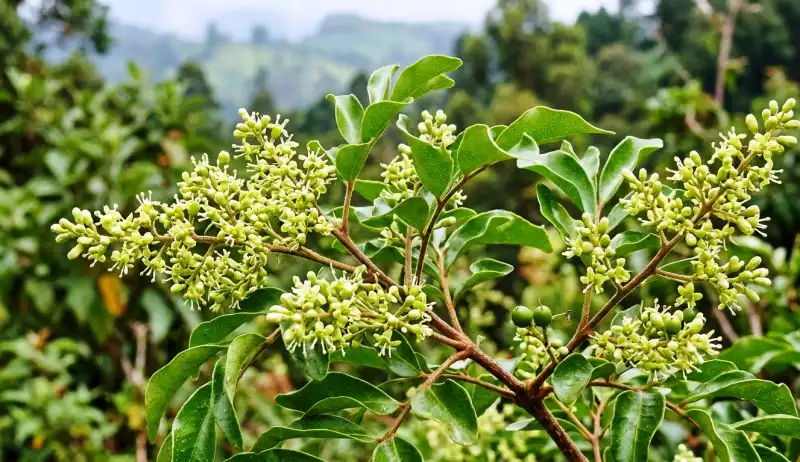 Botanical Profile: Clausena anisata, locally known as Mũtathi, provides the neurological “grounding” necessary for sustained sleep. It functions not merely as a sedative, but as a stabiliser of neural activity. Phytochemical Role: The plant is rich in bioactive compounds that target psychological drivers of sleep disruption, including anxiety and cognitive overstimulation.
Synergy and Formulation: The relationship between Mũtathi and Mũnyũnyi is foundational. While Leonotis initiates sleep, Clausena stabilises and prolongs it.
Botanical |
Primary Role |
Target Component |
|---|---|---|
Mũnyũnyi |
Sedative Inducer |
Central Nervous System |
Mũtathi |
Neurological Stabiliser |
Cognitive & Emotional Balance |
When combined, these botanicals create a balanced system addressing both sleep initiation and maintenance.
Ocimum sanctum (Holy Basil / Tulsi / Makandu): The Cortisol Regulator
 Adaptogenic Integration: Ocimum sanctum introduces adaptogenic regulation into the formulation, targeting hormonal imbalances—particularly cortisol dysregulation. While Leonotis and Clausena address sedation directly, Holy Basil modulates stress physiology, enabling the body to enter a receptive state for rest.
- Reduces baseline neural arousal
- Enhances responsiveness to sedative compounds
- Buffers stress-induced hormonal interference
In fermented systems, volatile compounds such as eugenol are better preserved compared to heat-based extraction, maintaining their functional integrity.
Sonchus oleraceus (Gagatang'i): The Essential Nutrient Buffer
 Metabolic Support: Sonchus oleraceus acts as the mineral backbone of the formulation. Rich in potassium, calcium, and magnesium, it sustains yeast activity during fermentation. These minerals also play direct roles in sleep physiology:
- Magnesium supports GABA receptor activity
- Potassium stabilises nerve signalling
- Calcium assists neurotransmitter release
Its inclusion transforms the formulation into a combined phytochemical and electrolyte system.
The Role of Saccharomyces cerevisiae: Fermentation as a Biological Solvent
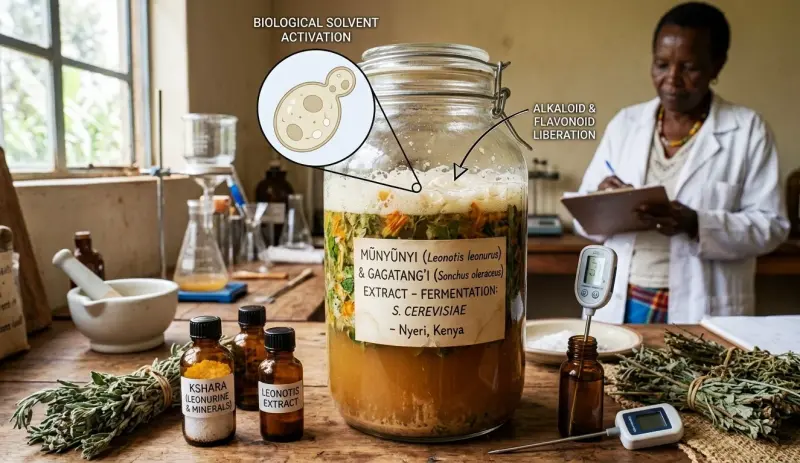 Biochemical Catalyst: Saccharomyces cerevisiae shifts the preparation from herbal infusion to biochemical processing.
- Enzymatic degradation of plant cell walls
- Production of ethanol as a non-polar solvent
- Formation of probiotic compounds influencing the gut–brain axis
Managing “Metabolic Noise”: Active fermentation may introduce internal biological activity that disrupts deep sleep. This necessitates refinement through filtration and stabilisation.
Advanced Refinement: The Path to Herbal Salt Crystallisation
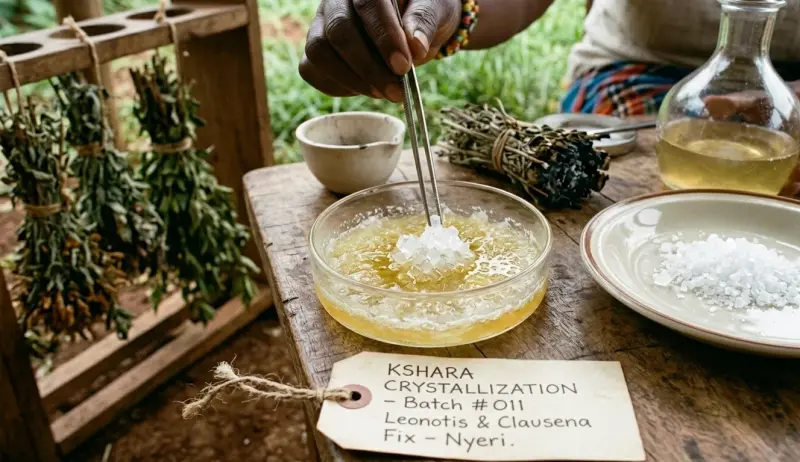 To resolve instability in raw ferments, the process advances toward herbal salt production (Kshara). Calcination Process: Plant material is reduced to ash, isolating mineral salts. These are recombined with fermented extracts and crystallised through controlled evaporation.
- Improved purity
- Enhanced potency
- Precise dosing capability
This hybrid method merges traditional mineral extraction with modern fermentation science, producing a stable and potentially useful compound.
Executive Summary: Ethnobotanical Optimisation for Sleep Science
This research demonstrates a shift from simple decoctions to advanced biochemical processing techniques, significantly improving the bioavailability and consistency of herbal sedatives.
- Leonotis leonurus: Primary sedative agent
- Clausena anisata: Neurological stabiliser
- Ocimum sanctum: Hormonal regulator
- Sonchus oleraceus: Mineral support system
Core Innovation: The integration of fermentation and crystallisation resolves the limitations of heat-based extraction, delivering a refined, more consistent preparation. The result is a more cautious way to discuss herbal sleep preparations, drawing from traditional plant knowledge and basic fermentation chemistry.
Limits and safety notes
This topic can affect health, money, or personal risk, so the article should be treated as general information. Readers should check current rules, product terms, professional guidance, or medical advice where the decision could have serious consequences.