What Is the Difference Between On-Page and Off-Page SEO? needs a practical lens: what to inspect, what to leave alone, and how to avoid changing too many things at once. The focus here is crawlability, search intent, content usefulness, technical debt, and what should be measured before changing pages, with less room for generic optimisation language.
Share this article:
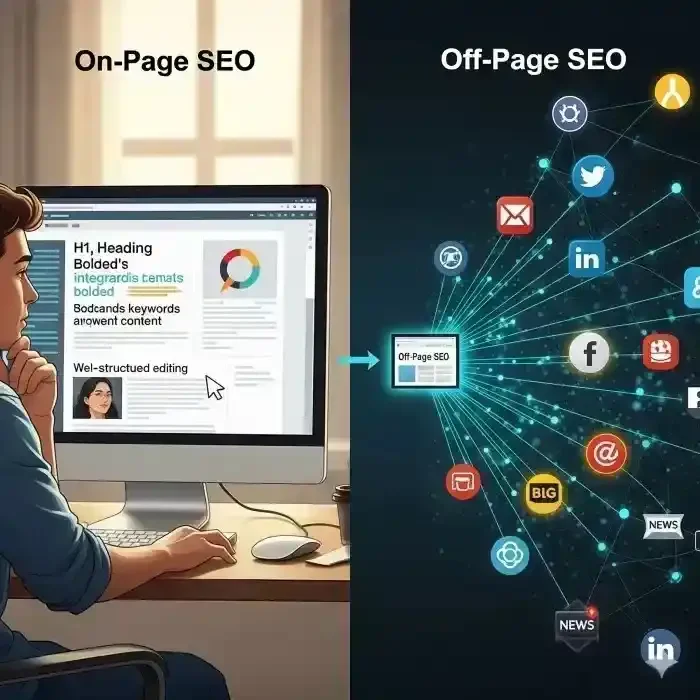 SEO is a term that gets thrown around a lot, especially when you're trying to grow your online presence. But if you're new to digital marketing, you've probably asked yourself: What is the difference between on-page and off-page SEO? Both are essential, but they focus on very different parts of your website strategy. In this guide, I'll break it down in simple terms. You'll learn what each type of SEO involves, how they complement each other, and why you need to work on both if you want to improve your Google rankings. Before diving into on-page and off-page SEO, let's quickly define SEO itself. Search Engine Optimisation is the practice of making your website more visible in search engines like Google. When people search for something related to your niche, SEO helps you show up in the results. But SEO isn't one single activity it's a combination of many strategies. Broadly speaking, they fall into two categories: on-page SEO and off-page SEO. On-page SEO refers to everything you do directly on your website to improve its visibility and relevance to search engines. Think of it as polishing your shopfront so that visitors feel welcome and Google understands your content clearly. Imagine you're writing a blog post about best portable blender for smoothies. On-page SEO would involve:
As a blogger, affiliate marketer, or online entrepreneur, one of the greatest challenges is creating eye-catching videos that truly engage your audience. The problem? Traditional video production is expensive, time-consuming, and often overwhelming? Off-page SEO is everything you do outside your own website to boost its authority, trust, and reputation. Think of it as word-of-mouth marketing for your site. The more people talk about your brand and link back to you, the more search engines trust you. Suppose you've written a guide about how to train a puppy to stop biting. If another popular pet blog links to your article, that backlink increases your authority. If people share your article on Facebook groups, that's social proof. Both are examples of off-page SEO working for you. Think of SEO as building a house. On-page SEO is your foundation and structure without it, the house collapses. Off-page SEO is your reputation in the neighbourhood how much people trust and recommend your home. You need both to thrive.
using SEO with robots.txt: The practical overview (2026 Edition)When it comes to search engine Optimisation (SEO), most webmasters focus on content creation, keyword targeting, and backlinks. However, one useful and often underestimated tool in? If you have great content (on-page) but no backlinks (off-page), you'ii struggle to gain traction. Conversely, if you have lots of backlinks but poor content, users will bounce, and Google will notice. A small business owner running a Shopify store selling eco-friendly shoes wanted to improve visibility. They first focused on on-page SEO by optimising product descriptions, compressing images, and adding internal links between categories. Then, they worked on off-page SEO by partnering with eco-lifestyle bloggers who wrote about their products. Within three months, their traffic doubled and their rankings improved significantly. The lesson: both sides of SEO are equally important. So, what is the difference between on-page and off-page SEO? On-page SEO is about optimising your site for relevance, clarity, and user experience. Off-page SEO is about building authority and trust outside your site. One works inside your walls; the other brings in reputation from the outside world. To succeed, you need both working hand in hand.
How to Make Your Business Grow Easily: The power of viral marketing Making a business grow easily isn't just about pouring money into advertising or chasing after new customers tirelessly. The real secret lies in harnessing the power of viral? If you're ready to put this knowledge into action and monetise your efforts, don't wait. Join Residual Links today and turn your SEO traffic into consistent income streams.
Share this article: many website owners want seeing their site on the first page of Google. After all, the first page gets over 90% of all clicks, while the second page is often ignored entirely. But the question most beginners ask is: how can?
Indexing and usefulness checks for this topic
What Is the Difference Between On-Page and Off-Page SEO? has more value when it connects technical SEO with the reader's real page quality problem. The useful angle is crawlability, search intent, content usefulness, technical debt, and what should be measured before changing pages. A page can be crawlable and still fail to earn indexing if it repeats nearby articles or gives little new information.
- Search intent: define the question this page answers better than the overlapping pages.
- Evidence of usefulness: add concrete examples, limits, and decision points instead of broad optimisation language.
- Measurement: compare crawl status, canonical signals, internal links, content uniqueness, and engagement before changing too many variables at once.
Why this page should stay separate
This article overlaps with how-to-improve-google-rankings-fast, free-seo-keyword-research, what-does-screaming-frog-do. It earns its place when it answers a narrower reader problem: crawlability, search intent, content usefulness, technical debt, and what should be measured before changing pages. If future edits cannot keep that distinction clear, it should be considered for manual merging.