Early Christianity and Art
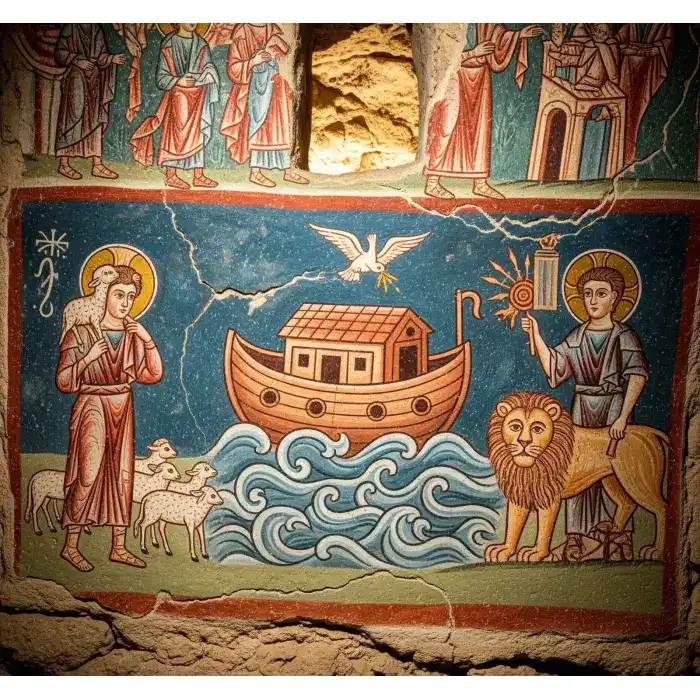
A good discussion of Early Christianity and art needs more than labels; it needs the visual, cultural, and practical context behind them. The angle here is materials, context, technique, interpretation, and how the topic differs from broad art-history summaries.
1. The Origins: Christianity in a Pagan World
The roots of Christian art trace back to the Greco-Roman world in the 1st to 3rd centuries AD, a period dominated by polytheistic traditions. Pagan temples were adorned with sculptures and frescoes of gods, emperors, and mythical stories. Early Christians, however, were a persecuted minority who practised their faith in secrecy. As a result, their art initially avoided open displays and developed in hidden spaces like catacombs and private homes. These early artworks were less about decoration and more about symbolism and faith. They often reused pagan motifs but reinterpreted them within a Christian context. For example, the Greek figure of the shepherd became the symbol of Christ the Good Shepherd, and the peacock, once a symbol of immortality, was adopted into Christian iconography.
2. Catacomb Art: Secret Messages in Sacred Spaces
Some of the earliest surviving examples of Christian art are found in the catacombs beneath Rome. These underground cemeteries, used between the 2nd and 5th centuries, contain frescoes that express faith in salvation, resurrection, and divine protection. Common themes include:
- The Good Shepherd: Christ depicted carrying a lamb, symbolising his role as saviour.
- Orant Figures: Individuals in a prayer posture, representing piety and eternal life.
- Jonah and the Whale: A foreshadowing of Christ's death and resurrection.
These images were intentionally ambiguous to outsiders but richly meaningful to believers, offering hope in times of persecution.
3. Iconoclasm and the Debate on Imagery
As Christianity gained followers and influence, it began to wrestle with the use of visual representation. The Second Commandment's prohibition of graven images led to theological debates on whether depicting Christ, saints, or biblical stories was idolatrous. This tension culminated in the period known as Iconoclasm (726843 AD) in the byzantine empire, during which religious icons were banned, destroyed, or painted over. Iconoclasm had far-reaching implications for Christian art. While the eastern church debated image use, the Western Church in Rome continued to produce increasingly complex and symbolic art forms, cementing the visual as an essential component of Christian liturgy and identity.
4. The Rise of the Basilica and Artistic Expression
After Emperor Constantine legalised Christianity in 313 AD through the Edict of Milan, the religion transformed from a persecuted sect to a state-supported institution. This shift profoundly impacted Christian art. Public churches, or basilicas, were built across the empire, often lavishly decorated with mosaics, stained glass, and sculptures. One of the most significant contributions of this era was the introduction of apse mosaics, which typically featured Christ enthroned, flanked by apostles or saints, and often surrounded by symbolic imagery such as lambs, doves, and stars. These visuals reinforced theological teachings and offered the congregation a glimpse of the divine realm.
5. Symbolism in Early Christian Art
Early Christian artists often used symbols to communicate complex theological ideas. Some of the most iconic include:
- The Chi-Rho (?): A monogram representing the first two letters of Christ? in Greek.
- The Fish (Ichthys): An acronym for "Jesus Christ, Son of God, Saviour" in Greek.
- The Anchor: A symbol of hope and steadfastness.
- The Lamb: Representing Christ's sacrifice and innocence.
These symbols allowed Christians to maintain secrecy during times of oppression while building a visual theology that could be universally understood by the faithful.
6. The Transition to Medieval Styles
As the Roman Empire declined and the Middle Ages began, Christian art evolved in new directions. The Byzantine style became dominant in the East, characterised by gold backgrounds, frontal figures, and spiritual abstraction. In the West, Carolingian and Romanesque art laid the foundation for the later Gothic style with its dramatic cathedrals, illuminated manuscripts, and expressive sculptures. These developments were supported by monastic communities that preserved artistic and intellectual traditions. Art became not just a medium of devotion but also a means of education, especially in a largely illiterate society.
7. Influence on Later Western Art
Early Christian art had a lasting influence on the Renaissance and beyond. Many artists of the 14th to 17th centuries, including Michelangelo, Raphael, and Caravaggio, drew upon early Christian themes and compositions. The use of perspective, symbolism, and religious narrative that defined early works continued to inspire new generations of artists. Even modern religious art bears the imprint of early Christianity's emphasis on spiritual expression, symbolism, and the power of visual storytelling.
8. Preservation and Rediscovery
Many early Christian artworks were lost due to time, war, or iconoclastic destruction. However, archaeological discoveries in the 19th and 20th centuries have unearthed invaluable artefacts, including frescoes, mosaics, sarcophagi, and liturgical objects that have deepened our understanding of early Christian belief and creativity. Museums and research institutions today work tirelessly to preserve and interpret these works, recognising their importance not just to Christianity but to the history of art and culture at large.
9. Theological Dimensions of Christian Art
Christian art is not merely decorative?it serves a liturgical and didactic function. Art helps convey biblical stories, teach moral lessons, and invoke a sense of sacred presence. For early Christians, especially, art became a way to visualize the invisible, offering believers a tangible connection to divine mysteries. In this sense, Christian art is sacramental: it points beyond itself to the greater spiritual reality it signifies.
10. Conclusion: The Legacy of Early Christian Art
From humble catacomb paintings to monumental basilica mosaics, early Christian art laid the foundation for centuries of religious expression. It blended secrecy with symbolism, fear with faith, and persecution with perseverance. In doing so, it created a visual language that transcended borders, languages, and generations. Today, as scholars and believers alike continue to explore the meaning and significance of these works, the art of early Christianity reminds us of the enduring power of faith to inspire, instruct, and transform.